

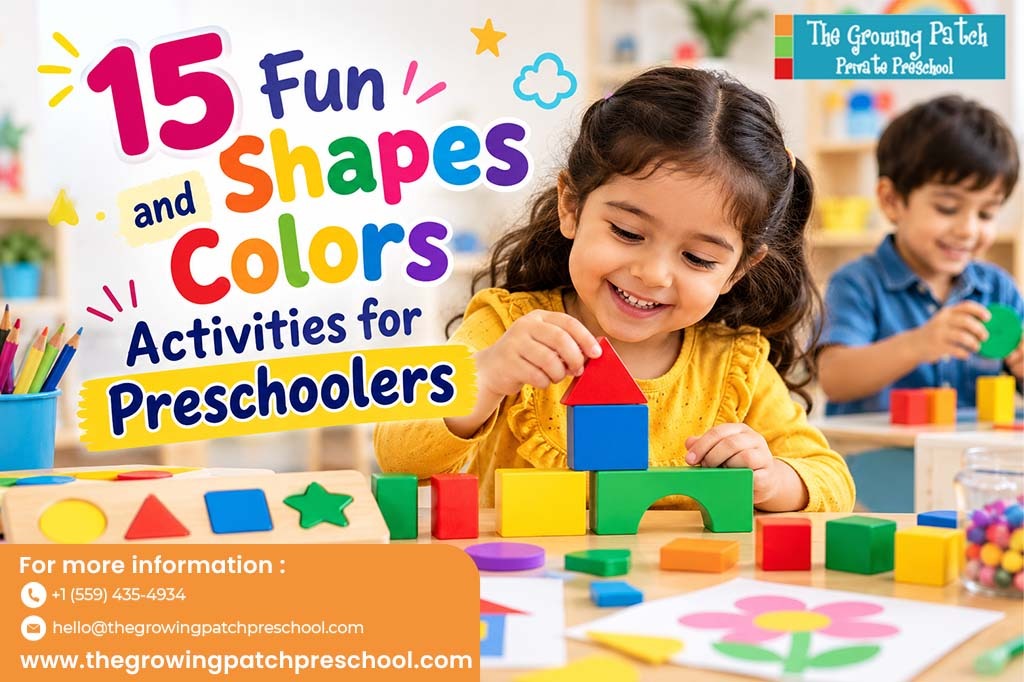
Early childhood education is a journey filled with discovery, play and foundational learning. Among the first academic concepts children encounter are shapes and colors which serve as building blocks for visual discrimination, spatial awareness and cognitive development. Introducing Shapes and Colours Activities for Preschoolers helps young learners make sense of the world around them while laying the groundwork for geometry and the art skills. This blog will cover engaging hands-on activities designed to make learning shapes and colors the joyful experience.
Importance of Shapes and Colors in Early Development
Before diving into games and crafts it helps to understand why Shapes and Colours Activities for Preschoolers are important. Children naturally process information long before children learn to read or write. Colors help children categorize objects, express preferences and develop vocabulary while shapes help children recognize patterns, understand spatial relationships and comprehend the letters and numbers.
When children engage with shapes and colors through multisensory experience like textured blocks mixing paints or sorting physical objects, children build strong neural pathways in the brain. Interactive learning transforms concepts into tangible realities encouraging curiosity, problem solving and fine motor control.
Hands-On Arts and Crafts for Color and Shape Recognition
Art is one of the effective mediums for young children to explore visual concepts freely. Through painting, cutting and gluing kids actively experiment with how different elements interact.
- Sponge‑Stamp Geometry: Cut shapes (circles, squares, triangles) out of kitchen sponges. Dip shapes in tempera paints and let children stamp shapes onto large paper to create repeating patterns and colorful collages.
- Tissue Paper Color‑Mixing Suncatchers: Cut a circle out of clear contact paper. Provide squares of yellow tissue paper. As children stick squares onto the surface children can discover firsthand how colors blend to create green.
- Shape Collage Animals: Provide the geometric paper shapes of various colors. Encourage children to glue triangles, rectangles and circles together to form the houses, trains or the animals reinforcing both the shape names and color identification.
Sensory Exploration and Sorting Challenges
Sensory bins and tactile play engage senses simultaneously making a learning stick.
- Sensory Rice Bin Sorting: Fill the bin with colored dry rice and hide the small plastic colored shapes inside. Have children use tongs or children’s fingers to sort shapes into the matching bowls.
- Playdough Shape Sculpting: Provide dough and cookie cutters in various geometric shapes. Let the children roll snakes of dough to outline the printed shape cards developing hand strength and the finger dexterity.
- Button and Bead Categorization: Give children a mix of buttons of different shapes, sizes and hues. Ask children to sort buttons by color and then resort buttons by the number of holes or overall shape.
Final Thoughts
Mastering fundamentals is an important milestone in every child’s early education journey. By incorporating the arts, physical games and tactile sensory experiences, educators and the parents can make learning dynamic and memorable. Engaging minds through interactive Shapes and Colours Activities for Preschoolers fosters a lifelong love for exploration and discovery. For families looking for a nurturing environment dedicated to early childhood development The Growing Patch offers an exceptional program designed to help every child thrive.
FAQs
Q1: Are hands-on activities more than flashcards for teaching young kids?
Ans: Yes hands‑on activities engage senses for better retention and deeper understanding.
Q2: What colors should I introduce to a toddler at once?
Ans: Start with the colors like red, blue and yellow before adding more.
Q3: Can daily household items be used for shape recognition games?
Ans: Absolutely items, like plates, blocks and boxes make everyday learning tools.
Q4: Why are fine motor skills important when learning shapes?
Ans: Tracing and cutting shapes helps strengthen the hand muscles for future writing.